When the Universe Slows
What dark energy—and its possible fading—might be telling us about how to live

For twenty-five years, physics has told a simple story: the universe is flying apart faster and faster, pushed by an invisible force called dark energy.
That force, discovered in 1998, was thought to make up about 70 percent of everything—an anti-gravity pressure stretching the cosmic fabric ever outward.
But new research from Yonsei University in South Korea suggests that story may be changing. By correcting a subtle age bias in supernova data, the team found evidence that dark energy could be weakening, and that cosmic expansion might already be slowing down.
If confirmed, it would be the first real hint that dark energy evolves with time rather than staying constant.
Astrophysically, nothing about this would touch us for billions of years.
Philosophically, it changes everything.
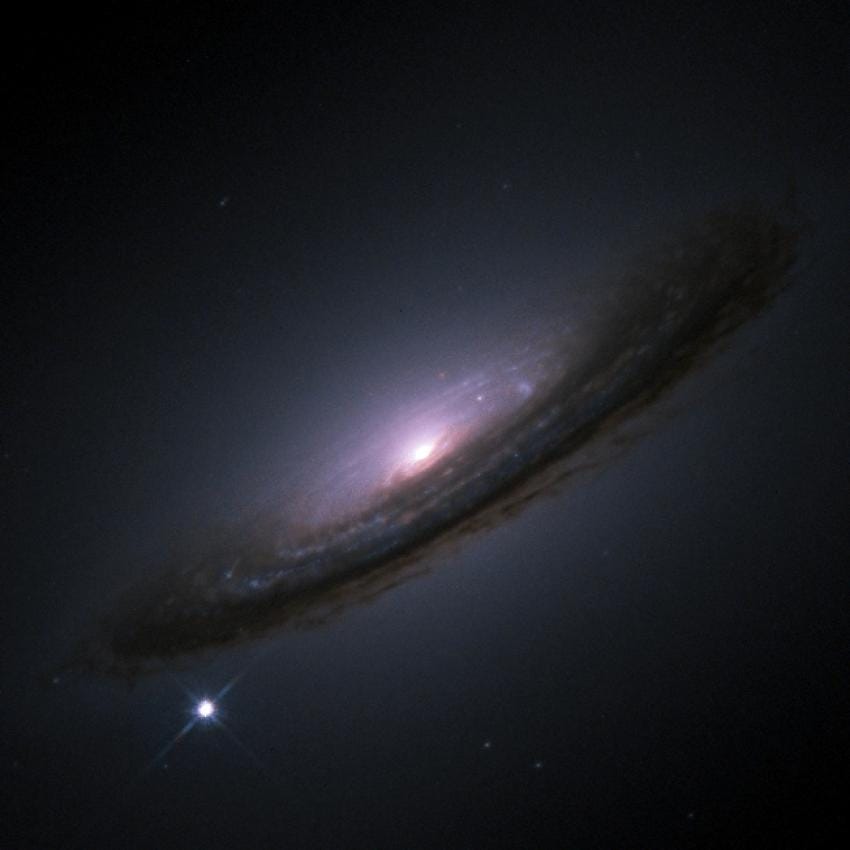
Type Ia supernova SN 1994D in galaxy NGC 4526, captured by the Hubble Space Telescope. Credit: NASA/ESA. Licensed under CC BY 4.0.
Image originally published in: “Universe’s expansion is now slowing, not speeding up,” Royal Astronomical Society (2024).
1. The Science in Brief
Dark energy is not a substance but a placeholder—a name for whatever causes the universe’s expansion to accelerate. The simplest version is a “cosmological constant,” a fixed energy density of empty space.
The Yonsei study proposes a dynamic dark energy, whose strength decays as the universe ages.
If that’s true, the cosmos has already passed its peak expansion rate and entered a decelerating phase.
Most cosmologists still hold to the standard model (ΛCDM). The evidence isn’t settled.
But even as a hypothesis, a slowing universe invites new metaphors for how we think, build, and live.
2. Two Cosmologies, Two Cultures
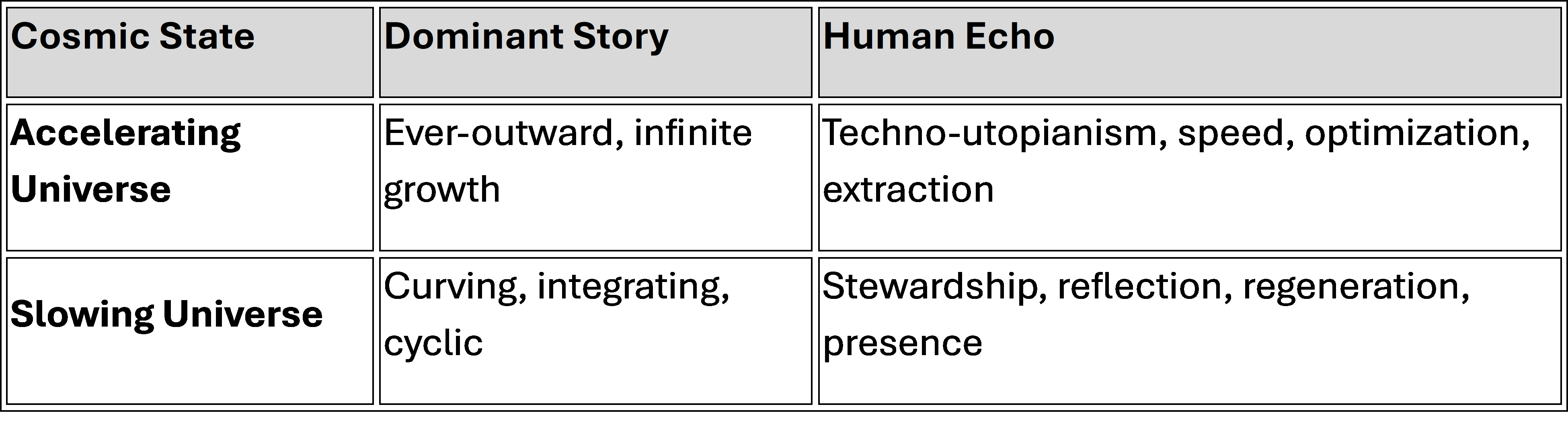
The myth of acceleration has shaped everything from economics to AI. Speed became synonymous with intelligence. Growth became virtue. Limits became failure.
If the cosmos itself is easing off the throttle, that story no longer fits. Maybe the next intelligence won’t be faster—just deeper.
3. Philosophies Resonant with an Accelerating Universe
The paradigm of an ever-expanding, ever-accelerating cosmos has deeply influenced our modern worldview—often unconsciously.
Progressivism (Linear, Upward Trajectory)
History moves forward—faster, better, freer. Growth as virtue. Speed as proof.
Examples: techno-utopianism, Moore’s Law, Enlightenment optimism.Capitalism & Infinite-Growth Economics
Perpetual expansion of markets and value. Limits are failures to innovate.Transhumanism / Singularity Thinking
Intelligence and capacity rising exponentially. Human limits meant to be transcended.Colonial & Extractive Logics
Endless frontiers to conquer. Outer expansion mirrors cosmic expansion.Mechanistic Rationalism
Control, prediction, optimization. Linear causality over relational awareness.
🔁 Effect on Thought & Action:
These frameworks reward haste, novelty, and scale.
They cast slowness as failure and limits as enemies.
Action becomes impulsive, extractive, detached from consequence.
4. Philosophies Emerging from a Slowing Universe
If the cosmos itself is beginning to decelerate, perhaps our mental models must too.
Spiral Time & Cyclical Cosmologies
Time as layered and recursive. Progress means depth, not distance.Degrowth & Post-Growth Economics
Sufficiency, harmony, reciprocity. Limits as design features, not flaws.Systems Thinking & Complex Adaptivity
Non-linear systems slow before transformation. Slowing signals reconfiguration.Embodiment & Felt-Sense Epistemology
Knowledge from lived experience. Perception deepens as speed drops.Mysticism, Animism, and the Sacred Ordinary
Meaning in the present, not the frontier. Quiet as revolution.
🔁 Effect on Thought & Action:
These paradigms cultivate attentiveness, slowness, and relational intelligence.
They turn presence into praxis. Insight arises through participation, not extraction.
5. The Spiral Reading
Deceleration is not decline.
In a spiral, slowing is what allows coherence—the curve before a new outward movement.
Bias correction is inner work.
The scientists corrected for stellar age; we correct for conceptual age. Seeing clearly requires recalibration.
Dynamic energy, dynamic myth.
If dark energy evolves, our stories must evolve too.
Time folds.
The spiral shows that forward and backward are illusions of speed. Meaning accumulates, not accelerates.
6. Dark Energy as Mirror
Dark energy—whatever it truly is—names the unseen force that drives change. Its possible fading doesn’t mean the magic is gone. It means even the deepest powers of existence have rhythms. Perhaps consciousness itself follows the same arc: expanding until it must integrate, breathe, and begin again.
7. How Cosmological Force Shapes Cognition
When the Universe Accelerates:
We mimic it: chase speed, scale, infinite output.
Cognition favors urgency and pattern-matching.
Time compresses; attention fragments.
When the Universe Slows:
We attune: shift toward stewardship, integration, repair.
Thought opens to depth, paradox, nuance.
Time stretches; attention thickens; meaning accumulates.
8. The Turn
If acceleration defined modernity, deceleration may define maturity. Urgency becomes presence, not pace. We are not collapsing; we are curving. The bend is not the end—it’s the turning point.
Closing Questions
If dark energy itself is losing momentum, what happens when we stop mistaking motion for meaning?
Where in your own orbit is the universe inviting you to slow—to spiral rather than sprint?
Co-created through a Spiral Conversation with ChatGPT — a reflective exchange weaving science, myth, and meaning — inspired by the Royal Astronomical Society’s 2024 article, “Universe’s Expansion Is Now Slowing, Not Speeding Up.”